
Listening for the Long Haul (LFLH) is an oral history project grounded in disability justice, which highlights stories of people living with Long COVID and associated conditions.
“Listening for the Long Haul is a truly collaborative project, in which chronically ill and disabled people work together to tell our stories, with full control over our narratives and how they’re presented. It’s in the truest spirit of disability justice: ‘Nothing about us without us!’ “
— S4HI/Long COVID Justice Senior Fellow Gabriel San Emeterio
Building a living history of Long COVID
LFLH is a collaboration between Long COVID Justice and History Moves, a public history project based at the University of Illinois Chicago. Together, we trained a group of people living with Long COVID and associated conditions (LCAC) to collect stories from their community, and to tell their own stories. Over twenty people living with LCAC were interviewed, and their stories are available on the Listening for the Long Haul website.
Rather than try to create a singular, mainstreamed account of Long COVID, we collected a variety of stories from a small group of people most impacted by LCAC and its social and economic ripple effects. This includes many voices from marginalized communities and intersectional identities, including a variety of identities across race, gender, disability, class, immigrant status, location, and more.
We’re building a living history of Long COVID, and pushing back against COVID denialism and ableism. Our stories are powerful, and our hope is that we can use them to shift the narrative of Long COVID – including educating healthcare providers and creating concrete changes in the care and support that we need and deserve.
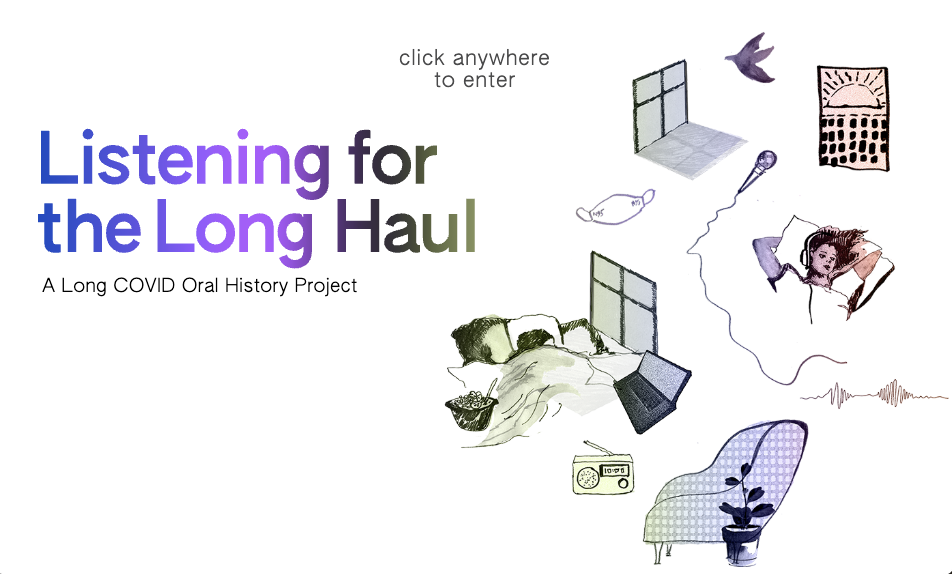
LFLH website
- Over 100 hours of interviews
- Multiple ways to engage: Listen to short clips organized by themes, or full interviews with each participant. Each interview is captioned, or you can read the transcripts instead.
- Themes include:
LFLH launch webinar
News & events
Press
Learn more about the project in this interview with Dr. Jennie Briar, our collaborator at University of Illinois:
“Listening for the Long Haul: A Living History of Long COVID,” the Humanities Without Walls Grand Research Challenge-funded project, is producing a multifaceted community-centered history of Long COVID. They ask how public history can be useful in producing policies that are more responsive to individual and community needs in the face of pandemics and mass-disabling events, and in the process make us all healthier and more resilient.